
Your website is one of the most valuable assets for your business. It’s often the first place potential customers visit to learn about your products, services, and brand. A well-designed website can build trust, generate leads, and increase sales. However, a poorly designed website can do the exact opposite.
Many businesses spend money on digital marketing, SEO, and social media campaigns but fail to convert visitors because their website has hidden problems. These issues may seem small, but together they can create a frustrating experience that encourages visitors to leave without taking action.
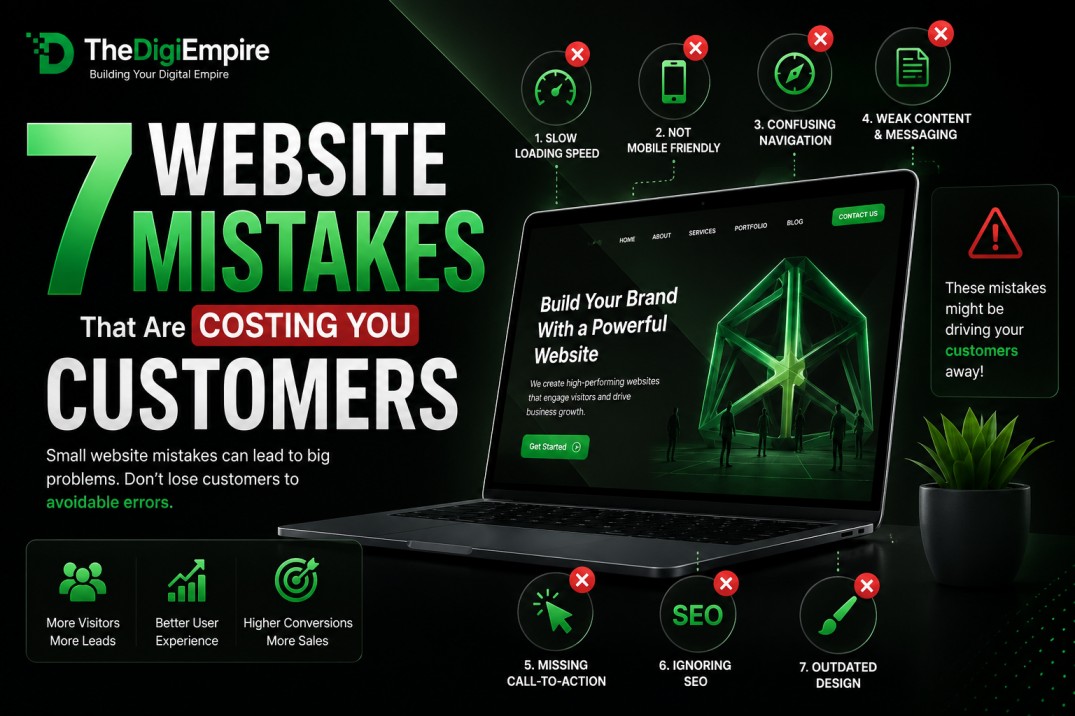
In this guide, we’ll discuss seven common website mistakes that may be costing you customers and show you how to fix them.
Table of Contents
- Why Your Website Matters
- Mistake #1: Slow Website Speed
- Mistake #2: Poor Mobile Experience
- Mistake #3: Confusing Navigation
- Mistake #4: Weak Content and Messaging
- Mistake #5: Missing Call-to-Action
- Mistake #6: Ignoring SEO
- Mistake #7: Outdated Website Design
- Bonus Tips to Improve Your Website
- Frequently Asked Questions
- Conclusion
Why Your Website Matters
Your website is available 24 hours a day, seven days a week. It represents your business even when your office is closed. Customers expect a website that is fast, easy to use, and filled with useful information.
If your website is difficult to navigate, slow to load, or looks outdated, visitors may lose confidence in your business and choose a competitor instead.
A great website not only attracts visitors but also encourages them to become customers.
Mistake #1: Slow Website Speed
One of the biggest reasons visitors leave a website is slow loading speed.
People expect websites to load quickly. If a page takes too long to appear, many users won’t wait.
Slow websites can lead to:
- Higher bounce rates
- Lower customer satisfaction
- Reduced search engine rankings
- Fewer inquiries and sales
How to Fix It
Improve your website speed by:
- Compressing images
- Using reliable web hosting
- Enabling browser caching
- Minimizing unnecessary plugins
- Optimizing CSS and JavaScript files
- Using a Content Delivery Network (CDN)
A faster website creates a better user experience and can improve your search engine rankings.
Mistake #2: Poor Mobile Experience
Today, a large percentage of internet users browse websites using smartphones and tablets.
If your website isn’t mobile-friendly, visitors may struggle to read text, click buttons, or complete forms.
Common mobile issues include:
- Tiny text
- Broken layouts
- Slow performance
- Difficult navigation
- Buttons that are too small
How to Fix It
Make sure your website:
- Uses responsive design
- Loads quickly on mobile devices
- Has readable text
- Features touch-friendly buttons
- Displays images correctly
A mobile-friendly website improves both user experience and SEO.
Mistake #3: Confusing Navigation
Visitors should be able to find information quickly.
If menus are cluttered or important pages are difficult to locate, users may leave before exploring your services.
A confusing website creates frustration and reduces conversions.
How to Fix It
Keep navigation simple.
Include only the most important menu items such as:
- Home
- About Us
- Services
- Portfolio
- Blog
- Contact
Use clear labels and maintain a consistent menu structure across all pages.
Mistake #4: Weak Content and Messaging
Many websites focus only on describing their business instead of explaining how they help customers.
Visitors want answers to questions like:
- What do you offer?
- Why should I choose you?
- How can you solve my problem?
- What should I do next?
If your content is unclear or filled with technical jargon, visitors may lose interest.
How to Fix It
Write content that is:
- Simple and easy to understand
- Focused on customer needs
- Well-organized with headings
- Free from spelling and grammar errors
- Supported by real examples and testimonials
Clear messaging builds trust and encourages visitors to take action.
Mistake #5: Missing Call-to-Action (CTA)
A website should guide visitors toward the next step.
Without a clear call-to-action, users may leave without contacting you.
Examples of effective CTAs include:
- Get a Free Quote
- Book a Consultation
- Contact Us Today
- Request a Demo
- Download Our Brochure
How to Fix It
Place clear CTAs throughout your website, especially on:
- Home page
- Service pages
- Blog posts
- Contact page
Use action-oriented language and make buttons easy to find.
Mistake #6: Ignoring SEO
A beautiful website won’t help if people can’t find it.
Search Engine Optimization (SEO) helps your website appear in Google search results when potential customers look for your products or services.
Ignoring SEO means losing valuable organic traffic.
Basic SEO Best Practices
- Use relevant keywords naturally.
- Write unique page titles and meta descriptions.
- Optimize images with descriptive alt text.
- Create high-quality content.
- Improve website speed.
- Build internal links between related pages.
- Keep your website updated.
Good SEO helps attract visitors who are already interested in what you offer.
Mistake #7: Outdated Website Design
An outdated website can make your business appear less professional, even if you provide excellent products or services.
Customers often judge credibility based on visual appearance.
Signs of an outdated website include:
- Old-fashioned layouts
- Low-quality images
- Inconsistent fonts
- Poor color combinations
- Broken links
- Missing security certificates
How to Fix It
Refresh your website by:
- Using a clean, modern layout
- Updating images and graphics
- Improving typography
- Ensuring mobile responsiveness
- Adding customer testimonials
- Displaying recent projects
- Keeping information current
A modern website creates a positive first impression.
Bonus Tips to Improve Your Website
Beyond fixing the common mistakes, here are a few extra ways to improve your website’s performance:
Add Customer Testimonials
Positive reviews build trust and reassure potential customers.
Use High-Quality Images
Professional images make your business look more credible and engaging.
Keep Contact Information Visible
Make it easy for visitors to reach you by displaying your phone number, email address, and contact form prominently.
Publish Helpful Blog Articles
Regular blog posts improve SEO, demonstrate expertise, and provide value to your audience.
Improve Website Security
Use HTTPS, update your software regularly, and protect your website against security threats.
A secure website builds confidence among visitors.
How to Know If Your Website Needs Improvement
Ask yourself these questions:
- Does my website load in under three seconds?
- Is it easy to use on mobile devices?
- Can visitors find information quickly?
- Do I have clear calls-to-action?
- Is my content helpful and easy to read?
- Are my pages optimized for search engines?
- Does my website reflect my current brand?
If you answered “no” to any of these questions, it may be time for a website upgrade.
Frequently Asked Questions
How often should I redesign my website?
Most businesses benefit from reviewing and updating their website every two to three years. Regular updates help maintain performance, security, and a modern appearance.
Why is website speed important?
Fast-loading websites improve user experience, reduce bounce rates, and support better search engine rankings.
Does mobile optimization affect SEO?
Yes. Search engines prioritize mobile-friendly websites, making responsive design an important ranking factor.
Can a website increase sales?
Absolutely. A well-designed website with strong content, clear calls-to-action, and good SEO can attract more visitors and convert them into customers.
Conclusion
Your website is more than an online brochure—it’s a powerful business tool that can attract new customers, build trust, and drive growth. However, even small issues such as slow loading times, poor mobile usability, confusing navigation, weak content, missing calls-to-action, neglected SEO, or an outdated design can discourage visitors and reduce conversions.
The good news is that these problems can be fixed. By regularly reviewing your website, focusing on user experience, and making thoughtful improvements, you can create a site that not only looks professional but also delivers real business results.
Remember, your website is often the first impression customers have of your business. Investing in a fast, modern, and user-friendly website is an investment in your company’s future.
Ready to Turn Your Website Into a Customer Magnet?
At TheDigiEmpire, we create fast, modern, and SEO-friendly websites designed to help businesses attract more visitors, generate qualified leads, and increase conversions. From website development and UI/UX design to SEO and digital marketing, our team provides complete solutions tailored to your business goals.
Contact TheDigiEmpire today and let us help you build a website that works as hard as you do.