
Marketing has always been one of the most important parts of growing a business. No matter how good your products or services are, people need to know about them before they can become your customers.
For many years, businesses relied on newspapers, television, radio, billboards, and magazines to promote their brands. These methods are known as traditional marketing. Today, with the rapid growth of the internet and smartphones, businesses are increasingly using digital marketing to reach customers online.
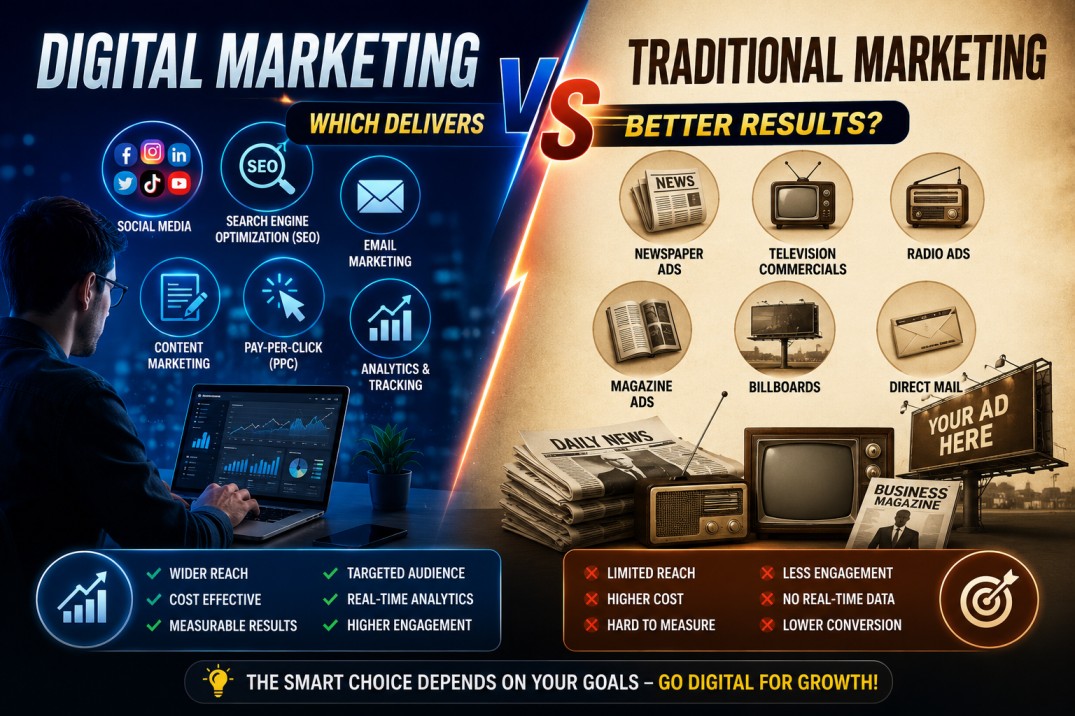
So, which one delivers better results?
The answer depends on your business goals, target audience, and budget. However, for most businesses in 2026, digital marketing offers greater flexibility, better targeting, and a higher return on investment.
In this guide, we’ll compare digital marketing and traditional marketing, explain their advantages and disadvantages, and help you decide which approach is right for your business.
Table of Contents
- What Is Digital Marketing?
- What Is Traditional Marketing?
- Digital Marketing vs Traditional Marketing
- Key Differences
- Benefits of Digital Marketing
- Benefits of Traditional Marketing
- Cost Comparison
- Which Marketing Strategy Is Better?
- Can Businesses Use Both?
- Frequently Asked Questions
- Conclusion
What Is Digital Marketing?
Digital marketing refers to promoting products or services using online platforms and digital technologies.
Businesses use websites, search engines, social media, email, and online advertising to connect with potential customers.
Common types of digital marketing include:
- Search Engine Optimization (SEO)
- Social Media Marketing
- Google Ads
- Email Marketing
- Content Marketing
- Video Marketing
- Influencer Marketing
- Mobile Marketing
One of the biggest advantages of digital marketing is that businesses can reach people almost anywhere in the world.
What Is Traditional Marketing?
Traditional marketing includes all offline methods used to promote a business.
These methods have been used successfully for decades and are still valuable in many industries.
Examples include:
- Television commercials
- Newspaper advertisements
- Radio advertisements
- Magazine ads
- Flyers and brochures
- Billboards
- Direct mail
- Event sponsorships
Traditional marketing focuses on reaching a broad audience through physical or broadcast media.
Digital Marketing vs Traditional Marketing
Although both methods aim to attract customers and increase sales, they work in different ways.
| Feature | Digital Marketing | Traditional Marketing |
|---|---|---|
| Reach | Global | Mostly Local or Regional |
| Cost | Affordable | Expensive |
| Target Audience | Highly Specific | Broad Audience |
| Performance Tracking | Real-Time | Limited |
| Customer Interaction | High | Low |
| Campaign Changes | Instant | Difficult |
| Return on Investment | Easy to Measure | Difficult to Measure |
Digital marketing gives businesses more control over their campaigns and allows them to adjust strategies quickly based on results.
Key Differences Between Digital and Traditional Marketing
1. Audience Reach
Digital marketing allows businesses to connect with customers across cities, states, and even countries.
Traditional marketing usually reaches people within a specific geographic area.
If your goal is to expand your customer base, digital marketing offers greater opportunities.
2. Cost
Marketing budgets are important for every business.
Running a newspaper advertisement or television commercial often requires a significant investment.
Digital marketing provides flexible pricing.
Businesses can start with a small budget and increase spending as they see positive results.
This makes digital marketing ideal for startups and small businesses.
3. Targeting
One of the biggest strengths of digital marketing is precise audience targeting.
You can target people based on:
- Age
- Gender
- Location
- Interests
- Online behavior
- Occupation
- Purchasing habits
Traditional marketing cannot offer this level of precision.
As a result, businesses may spend money reaching people who are not interested in their products.
4. Measurable Results
With digital marketing, businesses can track almost everything.
You can monitor:
- Website visitors
- Clicks
- Conversions
- Sales
- Leads
- Customer engagement
- Advertisement performance
This helps businesses understand what is working and improve future campaigns.
Traditional marketing provides far fewer performance insights.
5. Customer Engagement
Digital marketing encourages two-way communication.
Customers can:
- Leave comments
- Send messages
- Write reviews
- Share content
- Ask questions
Traditional marketing is mostly one-way communication.
Customers receive the message but have limited opportunities to interact immediately.
Benefits of Digital Marketing
Higher Return on Investment
Digital campaigns often generate better returns because businesses can target the right audience while controlling costs.
Better Customer Relationships
Social media, email, and online communities help businesses build long-term relationships with customers.
Faster Results
Paid advertising campaigns can begin generating traffic within hours.
SEO and content marketing may take longer, but they continue delivering value over time.
Easy Campaign Optimization
If an advertisement isn’t performing well, businesses can update it immediately.
This flexibility helps improve campaign performance quickly.
Global Reach
A local business can now sell products and services to customers across the country or around the world.
Benefits of Traditional Marketing
Traditional marketing still has its strengths.
Builds Local Brand Awareness
Billboards, newspapers, and local radio stations remain effective for reaching nearby customers.
High Trust Among Certain Audiences
Some customers, especially older generations, continue to trust print media and television advertising.
Strong Physical Presence
Printed brochures, banners, and business cards leave a lasting impression that digital ads sometimes cannot.
Effective for Events
Trade shows, exhibitions, and local events provide valuable opportunities for face-to-face interaction.
Which Businesses Benefit Most from Digital Marketing?
Digital marketing works particularly well for:
- Startups
- E-commerce businesses
- IT companies
- Educational institutions
- Healthcare providers
- Real estate agencies
- Restaurants
- Consultants
- Freelancers
- Manufacturers
Businesses looking for measurable growth often benefit from digital strategies.
Which Businesses Still Use Traditional Marketing?
Traditional marketing remains useful for:
- Local retail stores
- Political campaigns
- Large consumer brands
- Luxury products
- Community events
- Regional service providers
Many established companies combine traditional advertising with digital campaigns.
Cost Comparison
One of the biggest differences between the two approaches is cost.
Traditional marketing often requires significant investment before a campaign begins.
Examples include:
- Printing costs
- Television production
- Radio airtime
- Billboard rental
- Newspaper placement
Digital marketing offers flexible spending options.
Businesses can start with small budgets and gradually increase investment based on performance.
This reduces financial risk.
Which Marketing Strategy Delivers Better Results?
For most businesses in 2026, digital marketing delivers stronger results because it offers:
- Better targeting
- Lower costs
- Higher flexibility
- Real-time tracking
- Faster optimization
- Greater customer engagement
- Better lead generation
- Easier scalability
However, this doesn’t mean traditional marketing has become outdated.
The best strategy depends on your audience.
For example, a local event may benefit from newspaper advertising and billboards, while an online store will likely see better results from SEO, Google Ads, and social media marketing.
Should Businesses Use Both?
Absolutely.
Many successful businesses combine both strategies.
For example:
A retail store may advertise in a local newspaper while also running Facebook Ads.
A manufacturing company may participate in trade shows while generating leads through LinkedIn marketing.
A restaurant may distribute flyers while promoting offers on Instagram.
Using multiple channels creates more opportunities to reach potential customers.
Tips for Choosing the Right Marketing Strategy
Before investing in marketing, ask yourself:
- Who is my target audience?
- Where do my customers spend their time?
- What is my marketing budget?
- Do I want quick results or long-term growth?
- Can I measure campaign performance?
Your answers will help determine the most effective marketing approach.
Frequently Asked Questions
Is digital marketing replacing traditional marketing?
Digital marketing is growing rapidly, but traditional marketing still has value in specific industries and local markets.
Which is more affordable?
Digital marketing is generally more cost-effective because businesses can start with smaller budgets and target specific audiences.
Which strategy provides faster results?
Paid digital advertising can deliver results quickly, while traditional marketing often takes longer to measure its impact.
Can small businesses benefit from digital marketing?
Yes. Digital marketing is especially useful for small businesses because it allows them to compete with larger brands using limited budgets.
Conclusion
Both digital marketing and traditional marketing have their own strengths, and the right choice depends on your business goals, audience, and budget. Traditional marketing can still be effective for local campaigns and broad brand awareness, but digital marketing has become the preferred option for businesses seeking measurable growth, targeted reach, and better return on investment.
By combining the power of SEO, content marketing, social media, email campaigns, and online advertising, businesses can connect with customers more effectively than ever before. At the same time, traditional methods can complement these efforts in situations where physical visibility and local engagement are important.
The most successful businesses don’t always choose one over the other—they create a balanced marketing strategy that uses the strengths of both. As technology and customer behavior continue to evolve, staying flexible and adapting your approach will be key to achieving long-term success.
Ready to Grow Your Business?
At TheDigiEmpire, we help businesses build powerful digital marketing strategies that generate real results. From SEO and website development to social media marketing, AI-powered solutions, and mobile app development, our team provides customized services to help your business grow in today’s competitive digital landscape.
Contact us today to discover how digital marketing can take your business to the next level.