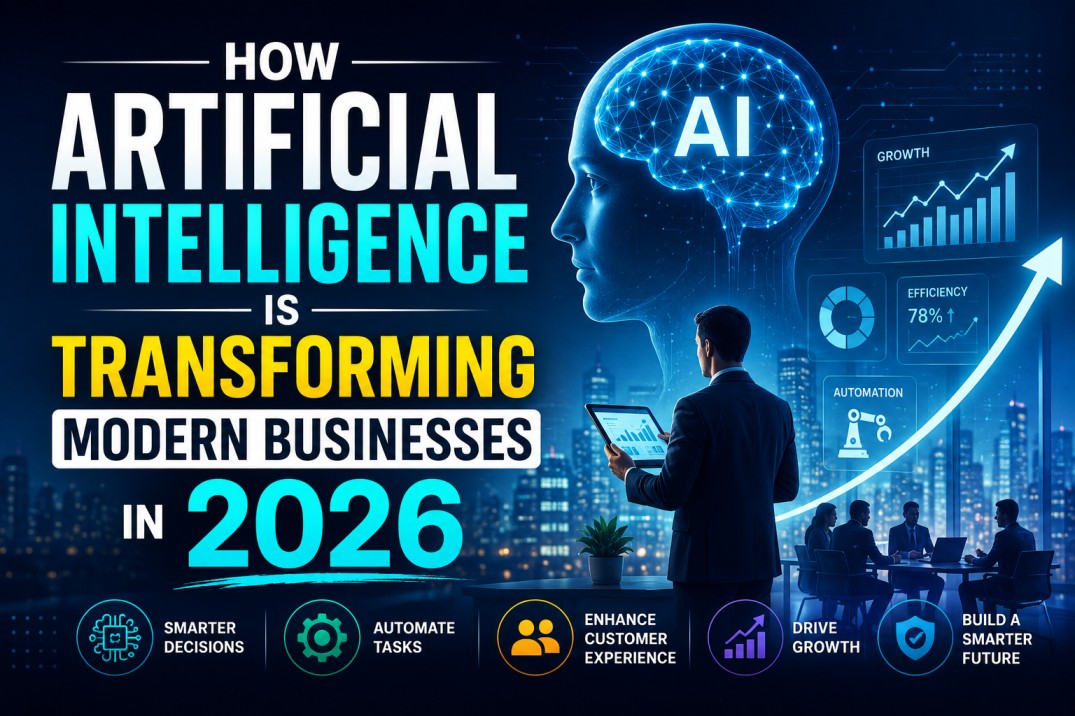

Artificial Intelligence (AI) is no longer just a futuristic concept. In 2026, it has become an essential part of how businesses operate, compete, and grow. From small startups to global enterprises, organizations are using AI to automate repetitive tasks, improve customer experiences, make smarter decisions, and increase overall productivity.
Whether you own a retail store, run a manufacturing company, manage a healthcare business, or offer professional services, AI has something valuable to offer. It helps businesses save time, reduce costs, and deliver better results without increasing workload.
In this article, we’ll explore how Artificial Intelligence is transforming modern businesses in 2026, why it matters, and how you can use it to stay ahead of the competition.
Table of Contents
- What Is Artificial Intelligence?
- Why AI Matters More Than Ever in 2026
- Benefits of AI for Modern Businesses
- How AI Is Changing Different Business Areas
- AI Tools Businesses Are Using Today
- Challenges of AI Adoption
- How Small Businesses Can Get Started with AI
- Future of AI in Business
- Frequently Asked Questions
- Conclusion
What Is Artificial Intelligence?
Artificial Intelligence is the ability of machines and software to perform tasks that usually require human intelligence. These tasks include learning, problem-solving, analyzing data, understanding language, recognizing images, and making decisions.
Unlike traditional software that follows fixed instructions, AI can learn from data and improve over time. This makes it useful for handling complex tasks more efficiently.
Today, AI powers many of the tools we use every day, including virtual assistants, recommendation systems, chatbots, search engines, and business analytics platforms.
Why AI Matters More Than Ever in 2026
The business world is changing rapidly. Customers expect faster responses, personalized experiences, and better service. At the same time, companies are under pressure to reduce costs and improve efficiency.
AI helps businesses meet these expectations by automating routine work and providing valuable insights from data.
Some key reasons businesses are investing in AI include:
- Faster decision-making
- Better customer support
- Improved productivity
- Reduced operational costs
- Enhanced security
- Smarter marketing campaigns
- Accurate sales forecasting
Companies that adopt AI early are often better positioned to adapt to changing market demands and maintain a competitive edge.
Key Benefits of Artificial Intelligence
1. Saves Time
Many business tasks are repetitive and time-consuming. AI can automate activities such as data entry, scheduling, email responses, invoice processing, and report generation.
This allows employees to focus on strategic work instead of routine tasks.
2. Improves Customer Service
Customers expect quick answers whenever they need help.
AI-powered chatbots and virtual assistants can answer common questions, provide product recommendations, and assist customers 24/7.
This leads to faster response times and higher customer satisfaction.
3. Better Decision Making
Businesses generate large amounts of data every day.
AI analyzes this information quickly and identifies patterns that humans might overlook.
Business owners can use these insights to make informed decisions about marketing, sales, inventory, pricing, and operations.
4. Reduces Costs
Automation reduces the need for manual work, minimizes errors, and increases efficiency.
As a result, businesses save money while improving productivity.
5. Personalizes Customer Experience
Modern customers expect personalized recommendations.
AI studies customer behavior and preferences to recommend products, services, and content that match individual interests.
This increases customer engagement and sales.
How AI Is Transforming Different Business Functions
Marketing
Marketing has changed dramatically with AI.
Businesses now use AI to:
- Create marketing content
- Analyze customer behavior
- Improve advertising performance
- Optimize email campaigns
- Generate social media ideas
- Track campaign performance
AI helps marketers reach the right audience with the right message at the right time.
Sales
AI supports sales teams by identifying potential customers and predicting buying behavior.
Sales professionals can:
- Find qualified leads
- Prioritize prospects
- Forecast sales
- Personalize communication
- Improve conversion rates
This allows businesses to close deals more efficiently.
Customer Support
Customer support is one of the biggest areas where AI has made an impact.
AI assistants can:
- Answer common questions
- Process service requests
- Track orders
- Schedule appointments
- Handle basic troubleshooting
Human agents can then focus on more complex customer issues.
Human Resources
Recruitment has become faster with AI.
HR teams use AI to:
- Screen resumes
- Match candidates with job roles
- Schedule interviews
- Analyze employee performance
- Improve onboarding
This reduces hiring time while improving recruitment quality.
Finance
Finance departments use AI for:
- Fraud detection
- Expense management
- Financial forecasting
- Invoice automation
- Risk analysis
AI improves accuracy while reducing manual work.
Manufacturing
Manufacturers are using AI to improve production quality and reduce downtime.
AI helps with:
- Predictive maintenance
- Quality control
- Inventory management
- Supply chain optimization
- Production planning
This improves efficiency while reducing waste.
Popular AI Tools Businesses Use in 2026
Many businesses have already integrated AI into their daily operations.
Some common categories include:
- AI writing assistants
- Customer support chatbots
- Image generation tools
- Video editing assistants
- Meeting transcription software
- Data analytics platforms
- Marketing automation tools
- CRM systems with AI features
- AI coding assistants
Businesses choose tools based on their goals and industry requirements.
Can Small Businesses Benefit from AI?
Absolutely.
You don’t need a large budget to use AI.
Many affordable AI tools help small businesses:
- Create marketing content
- Design graphics
- Build websites
- Respond to customer inquiries
- Schedule appointments
- Improve SEO
- Analyze website traffic
Small businesses can achieve significant productivity gains by adopting AI gradually.
Challenges of AI Adoption
Although AI offers many benefits, businesses should also be aware of potential challenges.
Data Privacy
Companies must protect customer information and comply with privacy regulations.
Employee Training
Employees need proper training to use AI tools effectively.
AI should support employees rather than replace their expertise.
Initial Investment
Some advanced AI systems require investment in software, infrastructure, or integration.
However, many cloud-based AI tools are affordable for businesses of all sizes.
Human Oversight
AI can make mistakes or produce inaccurate results.
Important decisions should always include human review and judgment.
The Future of AI in Business
Artificial Intelligence will continue to evolve over the coming years.
Businesses can expect:
- Smarter automation
- Better customer experiences
- Faster business operations
- Advanced predictive analytics
- More personalized marketing
- Improved cybersecurity
- Increased workplace productivity
Organizations that embrace AI responsibly will be better prepared for future opportunities and challenges.
Tips for Businesses Getting Started with AI
If you’re new to AI, start with small, practical steps.
- Identify repetitive tasks that consume time.
- Choose one or two AI tools that solve a specific problem.
- Train your team on how to use them effectively.
- Monitor results and adjust your approach as needed.
- Continue exploring new AI solutions as your business grows.
The goal isn’t to replace people—it’s to help your team work smarter and deliver greater value.
Frequently Asked Questions
Is AI only for large companies?
No. Many affordable AI tools are designed specifically for small and medium-sized businesses.
Will AI replace human employees?
AI is better suited for automating repetitive tasks. Human creativity, critical thinking, and relationship-building remain essential in most roles.
Is AI expensive to implement?
Not necessarily. Many AI tools offer free or low-cost plans, making them accessible to businesses of all sizes.
Can AI improve customer service?
Yes. AI-powered chatbots and virtual assistants can provide quick responses, answer common questions, and support customers around the clock.
Conclusion
Artificial Intelligence is reshaping the way businesses operate in 2026. It is helping organizations become more efficient, improve customer experiences, reduce costs, and make smarter decisions based on data. From marketing and sales to customer support and operations, AI is creating opportunities for businesses of every size.
The key to success is not adopting every new AI tool, but choosing solutions that align with your business goals and using them thoughtfully. Companies that combine AI with skilled teams and a clear strategy are likely to see the greatest long-term benefits.
Ready to Grow Your Business with AI?
Whether you’re looking to integrate AI into your website, automate business processes, or strengthen your digital presence, TheDigiEmpire can help. Our team specializes in AI-powered solutions, web development, digital marketing, SEO, and mobile app development to help businesses grow in today’s competitive digital landscape.
Get in touch with us today and discover how AI can transform your business.